Check BNB deduction conditions with evidence
Separate total holdings, available quantity, account settings and actual fees before drawing a conclusion about BNB deductions.
- Available quantityCheck usable BNB in the fee-paying account
- EligibilityCheck the product, deduction setting and current terms
- Fee recordRead the asset and amount actually charged
An enabled setting covers only one part of the check.
On this page
An enabled discount switch does not explain every fee. Total holdings, available quantity, settings and settlement records are different kinds of evidence. Arrange them by purpose and time before changing anything.
Start with one existing fee record. Write down the product, charge time, fee asset and quantity before checking the balance and setting that applied to it.
What does each record establish?
| Record | What it establishes | What it does not establish |
|---|---|---|
| Asset overview | The displayed holdings or valuation | Quantity available to a specific mechanism |
| Account balance | Availability at the observed location | Availability at an earlier time |
| Deduction setting | The observed switch state | Product eligibility or final settlement |
| Fee estimate | A preview under its assumptions | The final charge |
| Final fee record | The fee asset and quantity charged | The explanation for every discrepancy |
A useful question is specific: which fee, in which product, on which date, and in which asset? Before sharing evidence, remove names, email addresses, identity details and unrelated account information.
Total holdings are not necessarily available holdings
An overview may aggregate several account areas or purposes. Inspect the balance relevant to the charge and distinguish available quantity from assets committed elsewhere. A self-custody wallet screenshot is not evidence of an exchange-account balance.
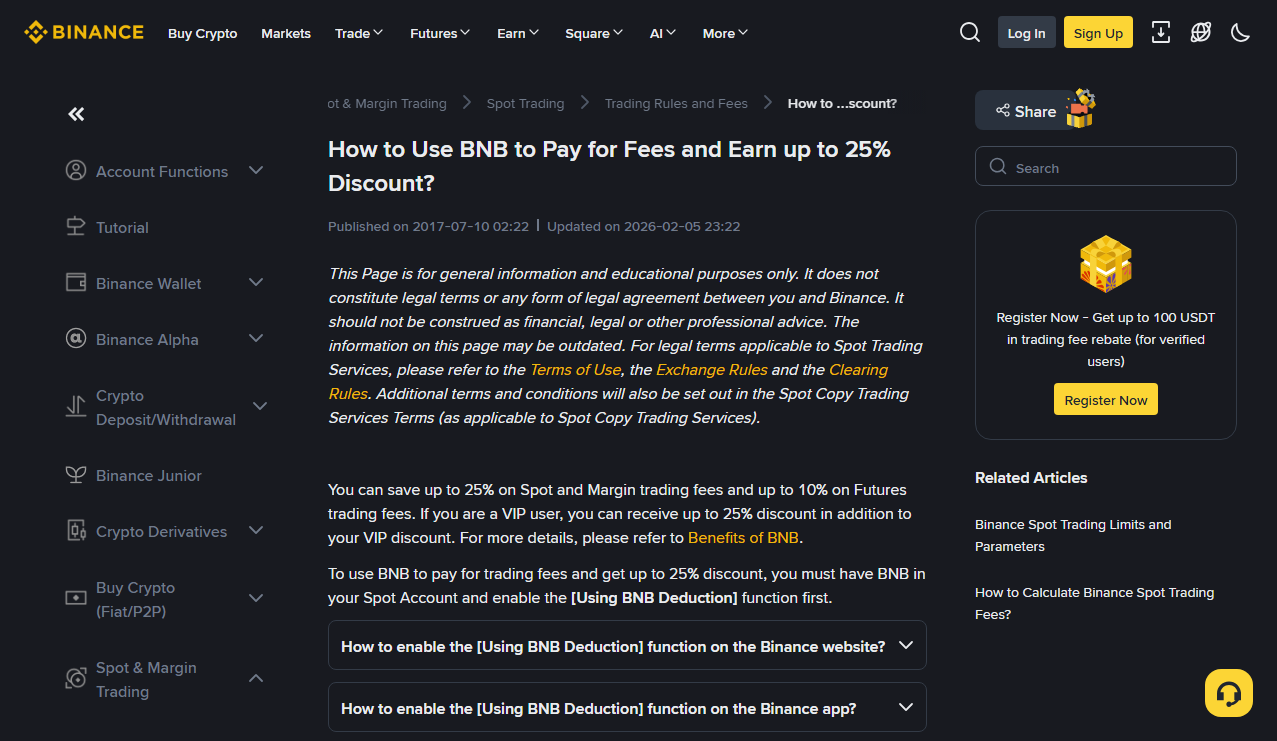
Binance’s BNB deduction FAQ, updated 6 February 2026 and checked 13 September 2026, requires BNB in the Spot Account and deduction enabled for the spot-fee treatment described here. Its fifth answer says insufficient BNB results in the original fee. Check the applicable account terms.
For example, suppose a discounted charge would require 0.002 BNB, but only 0.001 BNB was available in the relevant account. The balance is positive, yet insufficient. Do not record half the fee as discounted or assume another account supplied the difference. Compare the final debit with the applicable fee schedule. A larger balance observed today cannot establish what was available then.
Before buying more BNB, establish whether the missing condition is quantity, location or eligibility. Reassigning assets from another purpose can itself have costs. The gas-versus-deduction comparison helps identify a location mismatch.
Match the setting to the relevant time
A switch observed today does not prove it was enabled when an older fee occurred. If you lack historical evidence, record the past state as unknown. Do not manufacture certainty from a current screenshot.
Interface labels change. Compare the meaning of the current setting with current help documentation instead of relying on a permanent button position. New users can first read the registration and verification guide. Invitation association should be checked during its own flow, not assumed later because a BNB setting exists.
Read the final fee before comparing numbers
A preview can display a different asset or use a different conversion moment from the final record. A non-BNB estimate alone does not establish that deduction failed. Conversely, a favourable estimate does not guarantee an identical final result.
A two-line comparison
Hypothetical fee comparison: at 10:00, a preview for case A shows an estimated fee of 0.30 USDT; at 10:01, the final fee for the same case is 0.0005 BNB. Save both timestamps, units and all displayed decimals.
If a supporting conversion record establishes 600 USDT per BNB for that fee, then 0.0005 × 600 = 0.30 USDT. The amounts agree on that basis. Without that record, leave the value comparison unresolved; today's price cannot fill the gap. Even matching values do not prove a particular discount percentage: that requires the relevant original fee and eligibility. Check the record reference and final transaction amount before comparing the two lines.
Check whether a detailed view or export preserves more decimal places than the summary. Rounding is a possible explanation to verify, not a universal excuse.
Keep product rules and referral terms apart
One product’s discount does not establish another product’s treatment. Eligibility, fee basis, payment asset and any later reimbursement must each follow their corresponding terms. Where a rule provides a later credit, inspect the relevant period rather than assuming the first debit is the whole story. Equally, do not invent a future credit that has not appeared.
A linked referral code is separate evidence. Its specific benefit may depend on account, region, product and offer conditions. The BNB help page cannot verify a referral benefit. Leave unconfirmed benefits out of a calculation.
Prepare a precise question
List the charge, date, unit, relevant balance location, observation time for the setting and applicable rule. State whether you need clarification about eligibility, conversion or record classification. Use support inside the genuine account for account-specific decisions; this site cannot change charges or link invitations.
Never send passwords, verification codes, recovery codes or identity documents to someone offering to activate a discount. Once the evidence is clear, the reserve budget guide can estimate future consumption. A discount still does not justify increasing holdings or activity, and token prices remain risky.
Keep observations separate from questions
A private note is enough. Under “observed,” record the charge date, product, fee asset, quantity, original precision and source screen. Under “unconfirmed,” list missing facts such as historical availability or the effective date of a condition. This prevents an interpretation from looking like a platform-confirmed fact.
When support replies, preserve its date and scope. An explanation for one charge does not establish every historical fee. Keep any necessary account identifiers inside the genuine support channel, not in public comments. If the conditions were not met, record the actual charge and remove the unearned benefit from your budget. That is a valid conclusion; you do not need to increase activity to make the worksheet show a saving.